
The 50/200 Yard Zero — The Most Popular Way to Zero an AR-15
If you run a red dot on your AR-15, this is probably the zero you want. The 50/200 yard zero is the most popular general-purpose zero for civilian AR-15 owners — and for good reason. It keeps your point of impact within a couple of inches of your point of aim all the way from the muzzle out to about 200 yards, so you can hold dead center and hit what you're looking at without doing bullet-drop math in your head.
This guide covers what the 50/200 zero is, why it's so popular, how it stacks up against a 25-yard, 100-yard, or 25-meter military zero, and exactly how to sight your AR-15 in at 50 yards — with iron sights or a red dot.
What Is the 50/200 Yard Zero?
A "50/200 zero" means you zero your rifle at 50 yards — and because of the way the 5.56mm/.223 bullet flies, that same setting also puts you back on target at roughly 200 yards. That's where the name comes from.
Here's why: the bore of your rifle sits below your sight line, so the bullet leaves the barrel climbing to meet your line of sight. It crosses that line the first time at about 50 yards (your "near zero"), keeps rising slightly, peaks a couple of inches high around 100–150 yards, then falls back down to cross your line of sight a second time near 200 yards (your "far zero").
Why the 50/200 Zero Is So Popular
It's Flat Where It Counts
From the muzzle to about 225 yards, your impact stays within roughly 2 inches of your aim point. No holdover, no holdunder, no thinking — just aim center and shoot.
It's Built for Red Dots
A red dot has no magnification and no bullet-drop reticle, so a zero that lets you hold center across all common distances is ideal. This is the zero most instructors recommend for an Aimpoint, Holosun, EOTech, or similar optic.
50 Yards Is Easy to Find and Easy to See
Almost every range has a 50-yard line, and at 50 yards your target and your groups are easy to see clearly — much easier than reading a tight group at 100 yards through a non-magnified optic.
It Covers Realistic Distances
The overwhelming majority of defensive and general rifle shooting happens well inside 200 yards — exactly the window the 50/200 zero keeps flat.
50/200 vs. Other AR-15 Zeros
| Zero | Sight-In Distance | Stays Flat To | Best For |
|---|---|---|---|
| 50/200 Yard | 50 yds | ~0–225 yds | Red dots, general purpose, defense |
| 25-Yard | 25 yds | Close range; drops off past 150 | Indoor ranges, tight spaces |
| 100-Yard | 100 yds | Precision inside 200 | Magnified optics, hunting, bench |
| 25-Meter Military | 25 m (~27 yds) | Confirmed to 300 m | Military, LE, short-range access to a long zero |
Short version: if you have a 50-yard line and run a red dot, the 50/200 is hard to beat. If you only have a 25-yard indoor bay but want a true 300-meter capability, the 25-meter military zero is the better tool. Many shooters keep both in their back pocket.
What You Need
- Your AR-15 — any barrel length; shorter barrels shift impact slightly
- Ammunition — zero with the exact load you'll train and carry (55gr M193 and 62gr M855 are the common 5.56 choices)
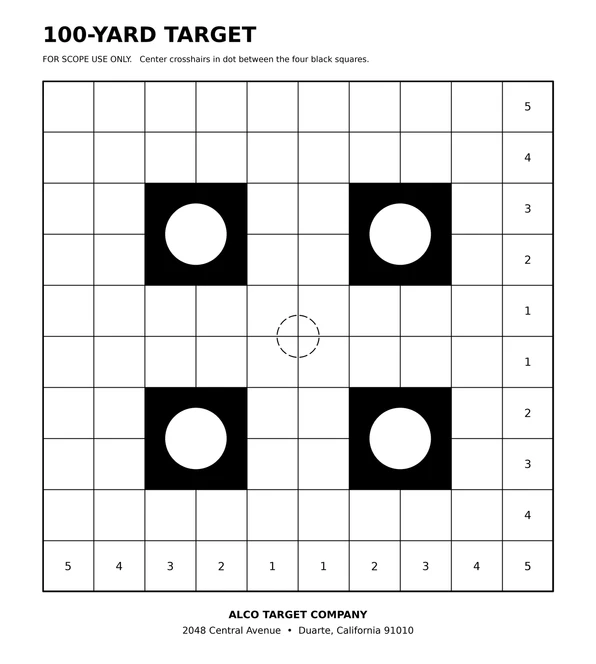
- A sight-in target with a grid — so you can measure your group offset and count clicks; the Alco Target Sighter has a 1" grid made for this
- A stable rest — bench, sandbags, or bipod
- Adjustment tool — for your optic turrets or iron sights
- Eye and ear protection — always
The Target to Use — and Why It's Different From a 25-Meter Zero
The 25-meter military zero uses a special target with an offset aiming point, because you're not actually trying to hit where you aim at 25 meters — you're building a 300-meter zero.
The 50/200 zero is the opposite: you want point of aim = point of impact, right at 50 yards. So you don't need an offset target — you need a clean grid sight-in target with a clear aiming point, so you can see exactly how far your group sits from center and turn that into clicks.
Step-by-Step: How to Zero Your AR-15 at 50 Yards
Step 1 — Set Your Target at Exactly 50 Yards
Use a marked line or a range finder. A few yards off will change your result, so confirm the distance before you start.
Step 2 — Get Stable
Shoot off a bench or bipod with a rear bag so your group shows the rifle's zero, not your wobble. The goal is to remove as much shooter error as possible.
Step 3 — Fire a 3-Round Group
Aim at the center aiming point. Fire a deliberate 3-round group, focusing on a consistent trigger press and cheek weld. Mark the group when you walk up to the target.
Step 4 — Measure the Offset
Using the target grid, measure how many inches high or low, and left or right, your group's center sits from the aiming point.
Step 5 — Calculate Your Clicks
At 50 yards, 1 MOA equals about 0.52 inches. Use your optic's click value:
| Sight Type | Click Value at 50 yds | Clicks to Move 1" |
|---|---|---|
| 1/4 MOA per click (most scopes) | ~0.13" | ~8 clicks |
| 1/2 MOA per click (EOTech, some red dots) | ~0.26" | ~4 clicks |
| 1 MOA per click (many red dots) | ~0.52" | ~2 clicks |
Step 6 — Make Your Adjustments
Adjust in the direction you want impact to move — shots low, move elevation UP; shots right, move windage LEFT.
Step 7 — Confirm
Fire another 3-round group. If it's centered, you're there. If not, repeat Steps 4–6 until your group sits on the aiming point.
Step 8 — Verify and Record
Fire one final 3-round group to confirm the zero is repeatable, then write down your settings so a bumped optic is a two-minute fix, not a re-zero.
✅ Target placed at exactly 50 yards
✅ Stable shooting position used
✅ First group fired and measured on the grid
✅ Clicks calculated and adjustments made
✅ Confirmation group centered on the aiming point
✅ Final group repeatable
✅ Zero documented — sight settings recorded
Don't Forget the Close-Range Offset
Your sight sits about 2.5"–2.6" above your bore. With a 50/200 zero, that means at very close range — inside about 10 yards — your bullet will hit roughly 2 inches low of where you aim, because it hasn't risen to meet your line of sight yet.
Expected Impact With a 50/200 Zero
| Distance | Impact (relative to point of aim) |
|---|---|
| 10 yards | Approximately 2" low |
| 25 yards | Approximately 1" low |
| 50 yards | On zero |
| 100 yards | Approximately 1.5–2" high |
| 150 yards | Approximately 1.5" high |
| 200 yards | On zero |
| 250 yards | Approximately 4" low |
| 300 yards | Approximately 9" low |
Common Zeroing Mistakes — And How to Avoid Them
Mistake 1 — Confusing a 25-Yard Zero With a 50/200
A 25-yard zero is a different trajectory that drops off faster past 150 yards. Zero at the distance you actually want — 50 yards — for the true 50/200 result.
Mistake 2 — Adjusting Off One Shot
Always fire a 3-round group before touching your turrets. A single shot tells you almost nothing because of natural variation.
Mistake 3 — Ignoring the Close-Range Offset
Up close you hit low because of sight-over-bore height. Know your holdover for shots inside 10 yards.
Mistake 4 — Switching Ammunition After Zeroing
Different loads print differently. Zero with the exact ammo you train and carry, and re-confirm any time you change types.
Mistake 5 — Not Recording Your Zero
Write down your click settings so a bumped optic is a quick fix instead of a full re-zero.
Frequently Asked Questions
Is a 50-yard zero the same as a 50/200 zero?
Yes. Zeroing at 50 yards automatically gives you a second near-zero around 200 yards with 5.56/.223, which is why it's called the 50/200.
Is the 50/200 the best zero for an AR-15 red dot?
For most shooters, yes — it keeps you within about 2 inches of your aim from 0 to 200 yards, which covers the vast majority of rifle shooting. If you only have a 25-yard range but want a 300-meter capability, the 25-meter military zero is the better fit.
Can I do a 50/200 zero at an indoor 25-yard range?
Not directly — you need a 50-yard line to zero at 50 yards. If you're limited to 25 yards, use the 25-meter military zero instead, which is designed for exactly that situation.
What target should I use for a 50/200 zero?
A grid sight-in target so you can measure your group and count clicks. The Alco Target Sighter with a 1" grid is made for it.
Does barrel length change my 50/200 zero?
Slightly. Shorter barrels lose a little velocity and shift impact a touch, but the 50/200 holds up well across common 10.5"–16" AR-15 barrels. Always confirm with your own rifle and ammo.
Get Your 50/200 Zero Dialed In
The Alco Target Sighter — a 1" grid on high-contrast paper — takes the guesswork out of a 50-yard zero. Set it at 50 yards, fire a group, count your clicks off the grid, and you're done. Printed at our Duarte, California facility in packs of 100.
✅ 1" reference grid for fast, precise click math
✅ Works at 50 and 100 yards
✅ High-contrast paper — easy to see your groups
✅ Printed at Alco Target — Made in the USA
✅ 100 targets per pack
Shop the Sighter target and our complete lineup of rifle, bullseye, and reactive targets at alcotarget.com or call us at 626-358-4814.
About Alco Target Company
Alco Target Company is a family-owned shooting target manufacturer based in Duarte, California. Founded in 1964 by Long Beach Police Officer Al Evanson and purchased in 1985 by Wayne Semain, Alco Target has been producing professional-grade paper, cardboard, and steel shooting targets for over 60 years. We are an officially licensed NRA, USPSA, IPSC, and IDPA target supplier.
2048 Central Avenue, Duarte, California 91010