
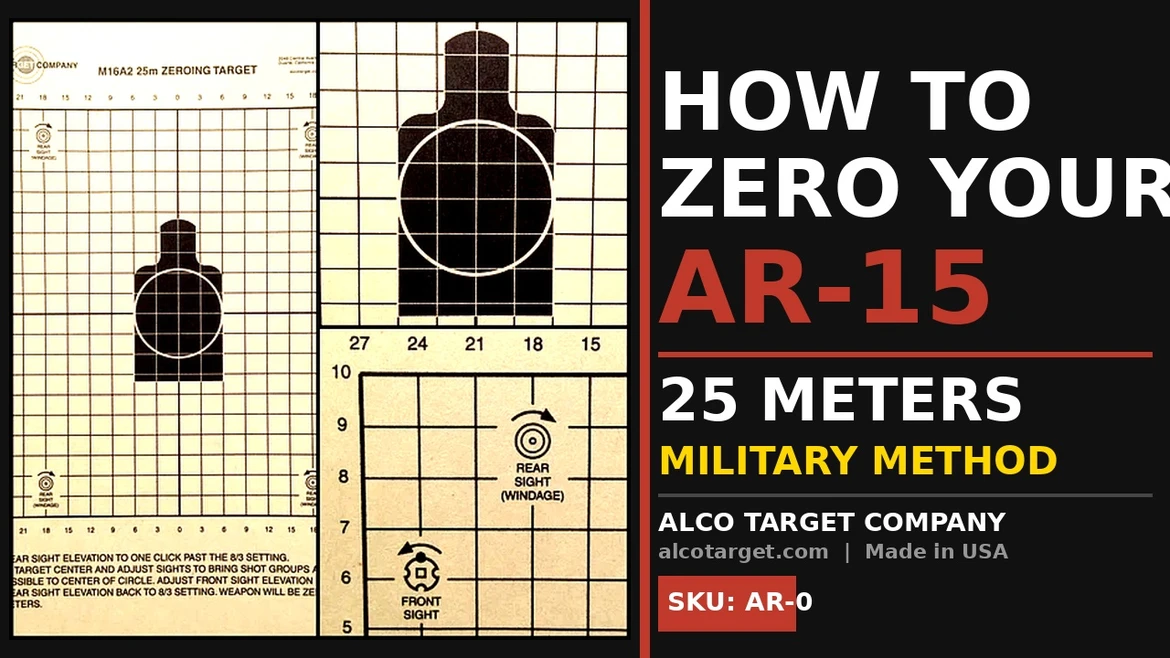
How to Zero Your AR-15 at 25 Meters — The Military Method
If you've ever watched a soldier or Marine sight in their rifle at a military range, you've seen the 25-meter zero in action. It's the most efficient, most practical, and most battle-tested way to zero — or sight in — an AR-15, and it works equally well for law enforcement officers, competitive shooters, and civilian AR-15 owners who want a reliable zero without needing a 300-yard range.
This guide covers everything you need to know about the 25-meter zero — what it is, how it compares to a 25-yard zero, why the military uses it, how to do it step by step with iron sights or a red dot, and what target to use. By the end you'll know exactly why one well-placed group at 25 meters gives you a confirmed zero at 300 meters — and how to sight your AR-15 in fast, efficiently, and correctly.
What Is the 25-Meter Zero?
The 25-meter zero is a zeroing method used by the United States Army, Marine Corps, and law enforcement agencies nationwide. It is based on the ballistic properties of the 5.56mm/.223 round — specifically the fact that the bullet's trajectory crosses the line of sight at two points: once close to the muzzle and once downrange.
When you zero an AR-15 at 25 meters, the bullet's path will also intersect with your line of sight at approximately 300 meters. This means a 25-meter zero gives you a functional 300-meter zero — without ever needing to shoot at 300 meters to confirm it.
For law enforcement officers, military personnel, and civilian AR-15 owners who may not have access to a 300-yard range, the 25-meter zero is the answer. Most indoor ranges, backyard ranges, and short-distance outdoor facilities can accommodate 25 meters — making this zeroing method universally accessible.
In U.S. Army terms this is known as the Improved Battlesight Zero (IBZ), and you'll also see it written as the 25/300 zero — a single 25-meter zero that confirms your rifle out to 300 meters.
25 Meters vs. 25 Yards — Does the Difference Matter?
This trips up a lot of shooters, because most American ranges are marked in yards, not meters. Here's the short answer: 25 meters equals about 27.3 yards — roughly 2.3 yards farther than the 25-yard line.
That small difference does change your result. If your range is marked in yards and you want the true military 25-meter/300-meter zero, set your target at about 27 yards, not 25. If you zero at a flat 25 yards instead, you'll still get a perfectly usable close-range zero — it just won't line up with the 300-meter crossing quite as precisely.
Prefer to work entirely in yards? The 36-yard zero is the popular yard-range cousin of this method — it produces a similar near/far dual crossing (roughly 36 yards and about 300 yards) and is a common choice for shooters who never think in meters. The 25-meter zero and the 36-yard zero are chasing the same goal: a confirmed short-range zero that also holds at distance.
Why Does the Military Use the 25-Meter Zero?
1. Ballistic Efficiency
The 5.56mm NATO round fired from an M4 or AR-15 with a standard 14.5" or 16" barrel has a specific trajectory that makes the 25-meter/300-meter dual zero mathematically accurate. The bullet rises slightly above line of sight after leaving the muzzle, crosses the line of sight at 25 meters, arcs slightly above the line of sight at midrange, and comes back down to cross the line of sight again at approximately 300 meters.
2. Range Accessibility
Not every military installation or training facility has a 300-meter range. But virtually every facility has a 25-meter range. By using the 25-meter zero, military armorers and range personnel can zero hundreds of rifles quickly and efficiently without needing extended range distances.
3. Speed and Efficiency
Zeroing at 25 meters is fast. A properly trained shooter can confirm a zero in 2-3 groups — often in under 10 minutes. Compare that to the time required to zero at 100 or 300 meters with multiple position changes, target walks, and extended range sessions.
4. Consistency and Standardization
The military zeroing standard is documented in field manuals and applied consistently across all services and installations. Every soldier and Marine zeros to the same standard — which means unit armorers, range officers, and commanders know exactly what to expect from a properly zeroed rifle.
What You Need to Zero Your AR-15 at 25 Meters
- Your AR-15 — M4, M16, M16A2, M16A4, or any AR-15 variant
- Ammunition — M193 55gr FMJ or M855 62gr FMJ for best results
- AR Zero Target — the official military 25-meter zeroing target (SKU: AR-0 at alcotarget.com)
- Stable shooting platform — bench rest, sandbags, or bipod for initial zeroing
- Screwdriver or adjustment tool — for iron sight adjustments
- Pen or marker — to mark your groups on the target
- Spotting scope or binoculars — helpful but not required at 25 meters
Understanding the AR Zero Target
The AR Zero target is not just any paper target — it is a specifically designed zeroing aid that takes the guesswork out of the 25-meter zero process.
Offset Aiming Point
The AR Zero target features a specific aiming point that accounts for the offset between your barrel bore and your sighting system. Because iron sights and optics sit above the bore axis — typically 2.5" to 2.6" for M4/AR-15 irons — the aiming point on the zeroing target is offset to compensate. When your group lands on the designated zero point, your rifle is correctly zeroed.
Grid Reference Points
The target includes grid reference points that allow you to measure exactly how far your group needs to move to reach zero — and calculate exactly how many clicks of adjustment are needed on your sights or optic.
Multiple Zeroing Boxes
The target includes multiple zeroing boxes so you can fire multiple groups and track your adjustments without constantly changing targets.
Zeroing a Red Dot, Optic, or Iron Sights at 25 Meters
The 25-meter method isn't just for iron sights — it works exactly the same for a red dot, holographic sight, LPVO, or magnified optic. Whether you're running an Aimpoint, EOTech, Holosun, ACOG, or A2 irons, the process is identical: fire a group, measure the offset on the target's grid, and dial your windage and elevation until the group sits on the zero point.
The one thing every optic shares is sight-over-bore height — your sight sits about 2.5"–2.6" above the barrel on an AR-15. The AR Zero target's offset aiming point is built to account for that, so it works the same whether you're zeroing irons or a red dot mounted at optic height. If you run a lower-third or absolute co-witness setup, zero your primary optic first, then confirm your backup irons against the same group.
Click values differ by optic (see the adjustment table above), so check whether yours moves in 1 MOA, ½ MOA, or ¼ MOA increments before you start turning turrets.
Step-by-Step: How to Zero Your AR-15 at 25 Meters
Step 1 — Set Up Your Target Correctly
Place your AR Zero target at exactly 25 meters (approximately 27.3 yards). Accuracy of target distance matters — a target placed at 23 or 27 meters will produce a different result than one placed at exactly 25 meters. Use a tape measure if your range does not have marked 25-meter firing points. Mount the target so the center is at approximately shoulder height when standing.
Step 2 — Establish a Stable Shooting Position
For initial zeroing, use the most stable platform available — a bench rest with sandbags is ideal. The goal during zeroing is to eliminate as much shooter error as possible so that your group location reflects only the mechanical zero of your rifle, not shooter technique.
Step 3 — Fire Your First 3-Round Group
Aim at the designated aiming point on your AR Zero target. Fire a deliberate 3-round group, taking your time with each shot. Focus on a consistent trigger press, natural point of aim, and consistent cheek weld. Mark this group with a pen or marker when you approach the target.
Step 4 — Measure Your Group
Measure the center of your group relative to the zero point on the target using the grid lines. You need two measurements:
- Vertical offset — how many inches high or low your group is from zero
- Horizontal offset — how many inches left or right your group is from zero
Step 5 — Calculate Your Adjustment
At 25 meters, most AR-15 iron sights and optics adjust at a rate of 1 MOA per click or 1/2 MOA per click. One MOA at 25 meters equals approximately 0.26 inches.
| Sight Type | Click Value at 25m | Clicks per 1/4" |
|---|---|---|
| A2 Iron Sights (standard) | 1 MOA = 0.26" | ~1 click per 0.26" |
| Aimpoint, EOTech (1 MOA/click) | 1 MOA = 0.26" | ~1 click per 0.26" |
| Most scopes (1/4 MOA/click) | 0.25 MOA = 0.065" | ~4 clicks per 0.26" |
| ACOG TA31 (0.5 MOA/click) | 0.5 MOA = 0.13" | ~2 clicks per 0.26" |
Step 6 — Make Your Adjustments
Make your calculated adjustments to your iron sights or optic. Always adjust your sights in the direction you want your bullet impact to move — if your shots are low, move the elevation adjustment UP. If shots are right, move windage LEFT.
Step 7 — Fire a Confirmation Group
Fire another 3-round group at the same aiming point. Measure the new group location. If it is on zero — you are done. If further adjustment is needed, repeat Steps 4-6 until your group lands on the zero point.
Step 8 — Fire a Final Confirmation Group
Once your group is on zero, fire one final 3-round confirmation group to verify your zero is solid and repeatable. A zero is not confirmed until you have a repeatable group landing on the zero point across multiple strings of fire.
✅ Target placed at exactly 25 meters
✅ Stable shooting position used
✅ First group fired and measured
✅ Adjustments calculated and made
✅ Confirmation group on zero point
✅ Final confirmation group repeatable
✅ Zero documented — sight settings recorded
Common Zeroing Mistakes — And How to Avoid Them
Mistake 1 — Using an Incorrect Target
Using a standard bullseye or silhouette target for a 25-meter zero will produce incorrect results unless you account for bore offset manually. Use the AR Zero target — it has the bore offset calculation built into the aiming point.
Mistake 2 — Inconsistent Shooting Position
If your position changes between shots your group will open up and your zero will be unreliable. Establish a consistent position and maintain it throughout the zeroing process.
Mistake 3 — Moving the Wrong Direction
Adjust your sights in the direction you want your bullet to move. If shots are low move the elevation UP. If shots are right move the windage LEFT.
Mistake 4 — Adjusting After One Shot
Always fire a group — minimum 3 rounds — before making adjustments. A single shot tells you almost nothing because of natural variation.
Mistake 5 — Not Recording Your Zero
Once you achieve zero, record your sight settings. Write down the number of clicks from mechanical zero for both elevation and windage so you can return to zero quickly if the sights are bumped.
Mistake 6 — Switching Ammunition
Different ammunition has different ballistics. Zero your rifle with the exact ammunition you plan to train and carry with — and re-confirm your zero any time you change ammunition types.
25-Meter Zero vs. Other Zeroing Methods
No single zero is "best" for every shooter — it depends on your range access and how far you shoot. The 50/200 yard zero (often just called the 50-yard zero) is the most popular all-purpose choice for civilian AR-15 owners running a red dot, because impacts stay within about 2 inches of the dot from 0 to 200 yards. The 25-yard zero is the common pick for indoor ranges and home-defense distances. The 25-meter zero below is the military and law enforcement standard — and the best option when you only have a short range but still want a rifle that's confirmed out to 300 meters.
| Method | Distance | Effective Range | Best For |
|---|---|---|---|
| 25-Meter Military Zero | 25m (27.3 yds) | 0-300m | Military, LE, general use |
| 50/200 Yard Zero | 50 yds | 0-200 yds | Civilian all-purpose, red dots, indoor ranges |
| 100-Yard Zero | 100 yds | 0-200 yds | Hunting, precision shooting |
| 200-Yard Zero | 200 yds | 0-400 yds | Long range precision |
| 300-Meter Zero | 300m | 0-500m | Military combat zero |
Is the 25-Meter Zero the Best Zero for an AR-15?
For military, law enforcement, and anyone who wants a single zero that performs from across-the-room distances out to 300 meters, yes. If you shoot mostly inside 200 yards and have a 50-yard line available, the 50/200 zero is a great alternative — but it can't match the 25-meter zero's range accessibility or its confirmed 300-meter hold.
Expected Impact at Distance with a 25-Meter Zero
| Distance | Expected Impact (relative to point of aim) |
|---|---|
| 25 meters | On zero |
| 50 meters | Approximately 1" high |
| 100 meters | Approximately 2" high |
| 200 meters | Approximately 1" high |
| 300 meters | On zero |
| 400 meters | Approximately 14" low |
| 500 meters | Approximately 36" low |
Frequently Asked Questions
Does a 25-meter zero really work at 300 meters? Yes. The 5.56mm round's trajectory crosses your line of sight twice — once at about 25 meters and again at about 300 meters. A confirmed 25-meter zero gives you a functional 300-meter zero without ever firing at 300.
Is a 25-yard zero the same as a 25-meter zero? Not exactly. 25 meters is about 27.3 yards, so a target at the 25-yard line sits roughly 2.3 yards closer. For the true military zero, set your target at about 27 yards. A flat 25-yard zero still works, but it won't line up with the 300-meter crossing as precisely.
Can you zero a red dot at 25 meters? Yes. The method and the AR Zero target work the same for red dots and optics as for iron sights — the offset aiming point accounts for the sight-over-bore height on an AR-15.
How many rounds does it take to zero an AR-15? Usually 9 to 15 rounds — a few 3-round groups — and often under 10 minutes with a stable rest.
What's the best zero for an AR-15? It depends on use. The 50/200 (50-yard) zero is the popular all-purpose civilian choice; the 25-meter zero is the military and law enforcement standard and the best pick when you only have a short range but want a 300-meter capability.
Shop AR Zero Targets at Alco Target
Alco Target Company has been producing professional shooting targets for law enforcement agencies, military training programs, and serious shooters since 1964. Our AR Zero target is the same military-format 25-meter zeroing target used at ranges across the country — printed at our Duarte, California facility on 8.5" x 11" paper in packs of 100.
✅ Official military 25-meter zeroing format
✅ Compatible with M4, M16, M16A2, M16A4, and AR-15 platforms
✅ 8.5" x 11" — fits any target stand
✅ Printed at Alco Target — Made in the USA
✅ 100 targets per pack
Shop the AR Zero target and our complete lineup of paper targets, law enforcement qualification targets, and specialty training targets at alcotarget.com or call us at 626-358-4814.
About Alco Target Company
Alco Target Company is a family-owned shooting target manufacturer based in Duarte, California. Founded in 1964 by Long Beach Police Officer Al Evanson and purchased in 1985 by Wayne Semain, Alco Target has been producing professional-grade paper, cardboard, and steel shooting targets for over 60 years. We are an officially licensed NRA, USPSA, IPSC, and IDPA target supplier.
2048 Central Avenue, Duarte, California 91010